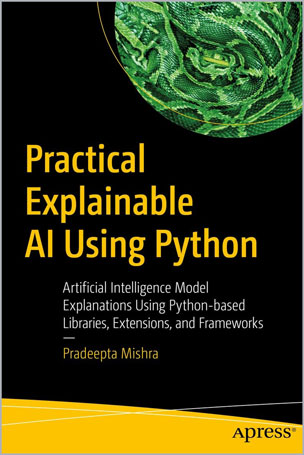
Learn the ins and outs of decisions, biases, and reliability of AI algorithms and how to make sense of these predictions. This book explores the so-called black-box models to boost the adaptability, interpretability, and explainability of the decisions made by AI algorithms using frameworks such as Python XAI libraries, TensorFlow 2.0+, Keras, and custom frameworks using Python wrappers.
You'll begin with an introduction to model explainability and interpretability basics, ethical consideration, and biases in predictions generated by AI models. Next, you'll look at methods and systems to interpret linear, non-linear, and time-series models used in AI. The book will also cover topics ranging from interpreting to understanding how an AI algorithm makes a decision
Further, you will learn the most complex ensemble models, explainability, and interpretability using frameworks such as Lime, SHAP, Skater, ELI5, etc. Moving forward, you will be introduced to model explainability for unstructured data, classification problems, and natural language processing–related tasks. Additionally, the book looks at counterfactual explanations for AI models. Practical Explainable AI Using Python shines the light on deep learning models, rule-based expert systems, and computer vision tasks using various XAI frameworks.
What You'll Learn
- Review the different ways of making an AI model interpretable and explainable
- Examine the biasness and good ethical practices of AI models
- Quantify, visualize, and estimate reliability of AI models
- Design frameworks to unbox the black-box models
- Assess the fairness of AI models
- Understand the building blocks of trust in AI models
- Increase the level of AI adoption
Who This Book Is For:
AI engineers, data scientists, and software developers involved in driving AI projects/ AI products.
Table of Contents
Chapter 1: Model Explainability and lnterpretability
Chapter 2: Al Ethics, Biasness, and Reliability
Chapter 3: Explainability for Linear Models
Chapter 4: Explainability for Non-Linear Models
Chapter 5: Explainability for Ensemble Models
Chapter 6: Explainability for Time Series Models
Chapter 7: Explainability for NLP
Chapter 8: Al Model Fairness Using a What-If Scenario
Chapter 9: Explainability for Deep Learning Models
Chapter 10: Counterfactual Explanations for XAI Models
Chapter 11: Contrastive Explanations for Machine Learning
Chapter 12: Model-Agnostic Explanations by Identifying Prediction Invariance
Chapter 13: Model Explainability for Rule-Based Expert Systems
Chapter 14: Model Explainability for Computer Vision
About the Author
Pradeepta Mishra is the Head of AI (Leni) at L&T Infotech (LTI), leading a large group of data scientists, computational linguistics experts, machine learning and deep learning experts in building next generation product, ‘Leni’ world’s first virtual data scientist. He was awarded as "India's Top - 40Under40DataScientists" by Analytics India Magazine. He is an author of 4 books, his first book has been recommended in HSLS center at the University of Pittsburgh, PA, USA. His latest book #PytorchRecipes was published by Apress. He has delivered a keynote session at the Global Data Science conference 2018, USA. He has delivered a TEDx talk on "Can Machines Think?", available on the official TEDx YouTube channel. He has delivered 200+ tech talks on data science, ML, DL, NLP, and AI in various Universities, meetups, technical institutions and community arranged forums.
ISBN
9781484271575
برند
Apress
تعداد صفحات
356
سال
2022
ایزی اگزم
نام مولف:
John Priece
نام ناشر:
Apress
متأسفانه این محصول در حال حاضر موجود نمی باشد