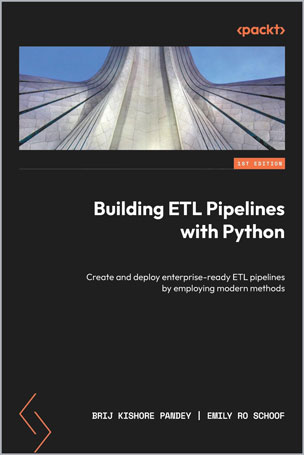
Develop production-ready ETL pipelines by leveraging Python libraries and deploying them for suitable use cases
Key Features:
- Understand how to set up a Python virtual environment with PyCharm
- Learn functional and object-oriented approaches to create ETL pipelines
- Create robust CI/CD processes for ETL pipelines
Book Description:
Modern extract, transform, and load (ETL) pipelines for data engineering have favored the Python language for its broad range of uses and a large assortment of tools, applications, and open source components. With its simplicity and extensive library support, Python has emerged as the undisputed choice for data processing.
In this book, you'll walk through the end-to-end process of ETL data pipeline development, starting with an introduction to the fundamentals of data pipelines and establishing a Python development environment to create pipelines. Once you've explored the ETL pipeline design principles and ET development process, you'll be equipped to design custom ETL pipelines. Next, you'll get to grips with the steps in the ETL process, which involves extracting valuable data; performing transformations, through cleaning, manipulation, and ensuring data integrity; and ultimately loading the processed data into storage systems. You'll also review several ETL modules in Python, comparing their pros and cons when building data pipelines and leveraging cloud tools, such as AWS, to create scalable data pipelines. Lastly, you'll learn about the concept of test-driven development for ETL pipelines to ensure safe deployments.
By the end of this book, you'll have worked on several hands-on examples to create high-performance ETL pipelines to develop robust, scalable, and resilient environments using Python.
What You Will Learn:
Explore the available libraries and tools to create ETL pipelines using Python
- Write clean and resilient ETL code in Python that can be extended and easily scaled
- Understand the best practices and design principles for creating ETL pipelines
- Orchestrate the ETL process and scale the ETL pipeline effectively
- Discover tools and services available in AWS for ETL pipelines
- Understand different testing strategies and implement them with the ETL process
Who this book is for:
If you are a data engineer or software professional looking to create enterprise-level ETL pipelines using Python, this book is for you. Fundamental knowledge of Python is a prerequisite.
Table of Contents
Part 1: Introduction to ETL, Data Pipelines, and Design Principles
Chapter 1: A Primer on Python and the Development Environment
Chapter 2: Understanding the ETL Process and Data Pipelines
Chapter 3: Design Principles for Creating Scalable and Resilient Pipelines
Part 2: Designing ETL Pipelines with Python
Chapter 4: Sourcing Insightful Data and Data Extraction Strategies
Chapter 5: Data Cleansing and Transformation
Chapter 6: Loading Transformed Data
Chapter 7: Tutorial - Building an End-to-End ETL Pipeline in Python
Chapter 8: Powerful ETL Libraries and Tools in Python
Part 3: Creating ETL Pipelines in AWS
Chapter 9: A Primer on AWS Tools for ETL Processes
Chapter 10: Tutorial - Creating an ETL Pipeline in AWS
Chapter 11: Building Robust Deployment Pipelines in AWS
Part 4: Automating and Scaling ETL Pipelines
Chapter 12: Orchestration and Scaling in ETL Pipelines
Chapter 13: Testing Strategies for ETL Pipelines
Chapter 14: Best Practices for ETL Pipelines
Chapter 15: Use Cases and Further Reading
About the Authors
Brij Kishore Pandey stands as a testament to dedication, innovation, and mastery in the vast domains of software engineering, data engineering, machine learning, and architectural design. His illustrious career, spanning over 14 years, has seen him wear multiple hats, transitioning seamlessly between roles and consistently pushing the boundaries of technological advancement. He has a degree in electrical and electronics engineering. His work history includes the likes of JP Morgan Chase, American Express, 3M Company, Alaska Airlines, and Cigna Healthcare. He is currently working as a principal software engineer at Automatic Data Processing Inc. (ADP). Originally from India, he resides in Parsippany, New Jersey, with his wife and daughter.
Emily Ro Schoof is a dedicated data specialist with a global perspective, showcasing her expertise as a data scientist and data engineer on both national and international platforms. Drawing from a background rooted in healthcare and experimental design, she brings a unique perspective of expertise to her data analytic roles. Emily's multifaceted career ranges from working with UNICEF to design automated forecasting algorithms to identify conflict anomalies using near real-time media monitoring to serving as a subject matter expert for General Assembly's Data Engineering course content and design. Her mission is to empower individuals to leverage data for positive impact. Emily holds the strong belief that providing easy access to resources that merge theory and real-world applications is the essential first step in this process.
ISBN
9781804615256
برند
Packt
تعداد صفحات
246
سال
2023
ایزی اگزم
نام مولف:
John Priece
نام ناشر:
Packt
متأسفانه این محصول در حال حاضر موجود نمی باشد